An Intimate Conversation between Fabien BONNIN
& Arnaud DUFEYS
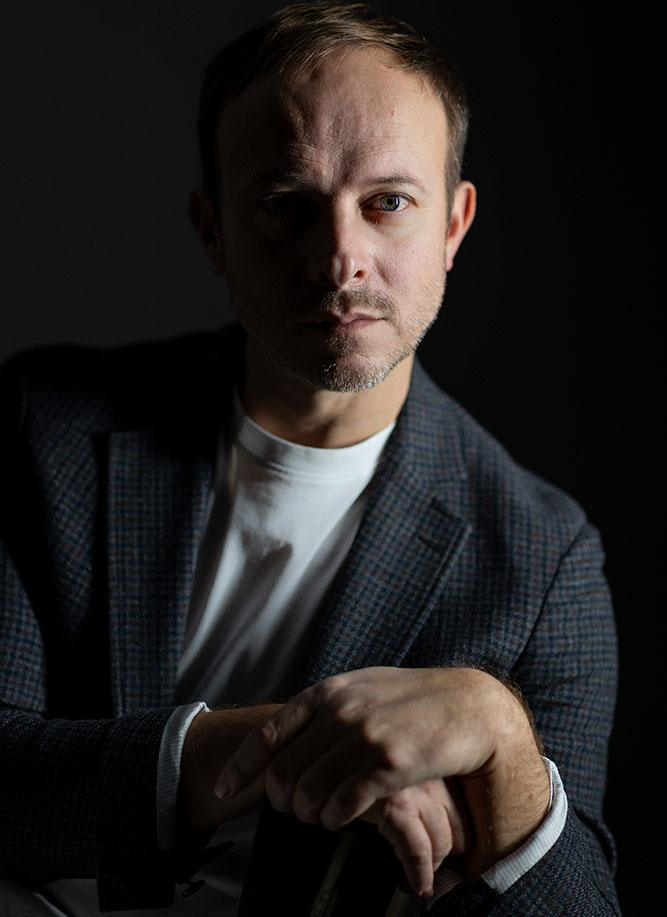
After twenty-five years in the luxury industry, particularly in fashion, Fabien BONNIN has developed a distinctive perspective—instinctive, curious, free, and deeply creative. Trained by the most demanding fashion houses and enriched by extensive hands-on experience, he now moves beyond the boundaries of fashion to connect disciplines and support brands, groups, and artists in shaping and harmonising their projects. With a cross-disciplinary vision, he conceives and rethinks products, customer experiences, and global strategies, with the aim of building meaningful and distinctive worlds.
A role as a harmoniser—or a builder—which he explains here.
What is your background?
I grew up in the Berry region, where I completed my studies before joining ESMOD Paris as a fashion designer and pattern maker. Alongside my studies, I always worked in retail. Those years in the field proved decisive during my training: they taught me how to understand customers from the inside, how to read who they are in less than two minutes, and how to ensure that—beyond being satisfied—everyone genuinely enjoys the experience.
At the end of my studies, I received the comité Colbert Prize. Beyond the collection I presented, I was already articulating the global vision of my brand: the emotions to be evoked, the message to be conveyed, the boutique environment designed as its setting, and the communication strategies that would support it.
It was during an internship at Kenzo that I realised my true strength lay less in revolutionising fashion than in elevating creative visions. I then made a promise to myself to become a key partner to creatives.
Why fashion?
As a child, my blankie object was none other than the satin care labels sewn inside our clothes. The feel of the fabric between my fingers—or against my lips—was reassuring, and to be completely honest, I still catch myself doing it under pressure. It is my own personal “madeleine de Proust”.
My mother, a seamstress, also immersed me very early in the world of fashion. I can still picture myself sitting beside the sewing machine, touching the fabrics, feeling them glide between my fingers, already allowing my imagination to sketch ideas. I experienced those moments intensely—my senses fully awakened.
Finally, I was an altar boy, and I believe it was during that time that I learned to perceive beauty as a language. My red alb trimmed with white lace, the choreography of gestures, the scent of incense prepared in the sacristy, the resonance of chants or the bells I rang in that small village church—everything belonged to an aesthetic of meaning, to a carefully orchestrated art form. It was my first experience of beauty taking shape before my eyes, of a total art form where every detail mattered.
What do these 25 years represent for you today, with hindsight?
What I am most proud of is having dared to say yes to roles and projects where I was not necessarily expected, and of having made decisions that stepped outside the so-called “classic” framework. I learned to trust my instinct—to listen to that inner voice that was always guiding me.
I ran the Lanvin boutique for nearly ten years. I have also collaborated with multiple creative directors, looked after many celebrities, led merchandising teams, and travelled extensively around the world to better understand our clients—their cultures and their environments. I have worked just as much with independent houses as with renowned groups such as LVMH or Richemont, as well as with emerging young talents.
Today, I wish to broaden my horizons and move beyond the sole world of fashion, as I observe every day just how strong this need is—and I know that I can bring both my expertise and my intuition to it.
What sets you apart in this field?
I believe it is my multidisciplinary approach: I work across both strategic and creative dimensions.
I am involved upstream, to help structure a vision; at the core, to harmonise creative and strategic elements; and downstream, to ensure the coherence and accuracy of the overall experience.
I have always felt the need to connect the creative thinking of founders or artistic directors with executive strategic challenges. In parallel, I shape the contours of the brand universe—its experience and its emotional resonance—while always keeping in focus the customer being addressed.
This harmony ultimately gives each project strength and singularity, becoming a tangible driver of growth and recognition.
Which collaborations or encounters have been most defining for you?
Without hesitation, my collaboration with Alber Elbaz at Lanvin. The twelve years I spent by his side were an extraordinary opportunity at the very start of my career. Alber was a genius—of fashion, of course, but also of storytelling, subtle marketing, and staging.
He taught me that craftsmanship, authenticity, and dream—enhanced by a touch of humour—can form a perfect equation. With him, I understood more than ever that fashion is not so much a profession as it is a passion.
Another collaboration proved just as formative, this time from a business perspective: a triangular collaboration with Philippe Fortunato and Ramon Ros, then respectively CEO and International Director of Givenchy. Over five years, they taught me how to be agile, to innovate, to analyse differently, to orchestrate with precision—and above all, to build.
Two collaborations. Two languages. Two worlds.
One gave me a sense of beauty, craftsmanship, and staging.
The other gave me vision, rigour, and the ability to build.
Together, they shaped my perspective and the way I operate within this field.
What, concretely, gave you both the desire and the legitimacy to extend your support beyond fashion to other forms of expression?
Working for houses such as Lanvin, Dior, Givenchy, or Montblanc immediately trains you in excellence—in the importance of detail, the rigor of both gesture and idea, and in “thinking big” as a natural reflex. Very early on, I understood that these houses were not merely creating products, but visions—and that those visions had to be expressed across every dimension of the brand.
The desire to expand my activities beyond fashion arose from the combination of the experience I have accumulated and a deep need to bring forth subtle coherences—those that are felt even before they are seen. This is precisely what many houses, groups, hotels, or artists are seeking today: a vision that harmonises, reveals, and connects.
Who—or what—led you to make this choice?
I remember that Charles Jeffrey, founder of the eponymous brand, used to call me his “Business Therapist.”
I have always been the person people turned to for a transversal perspective—the one who built bridges, clarified ideas, structured thinking, and gave meaning. The one entrusted with still-confidential projects, or who supported professionals in search of renewed momentum.
With hindsight, it is clear that I was already playing this role—without yet naming it.
Interview : Arnaud DUFEYS – Makintoshfilms
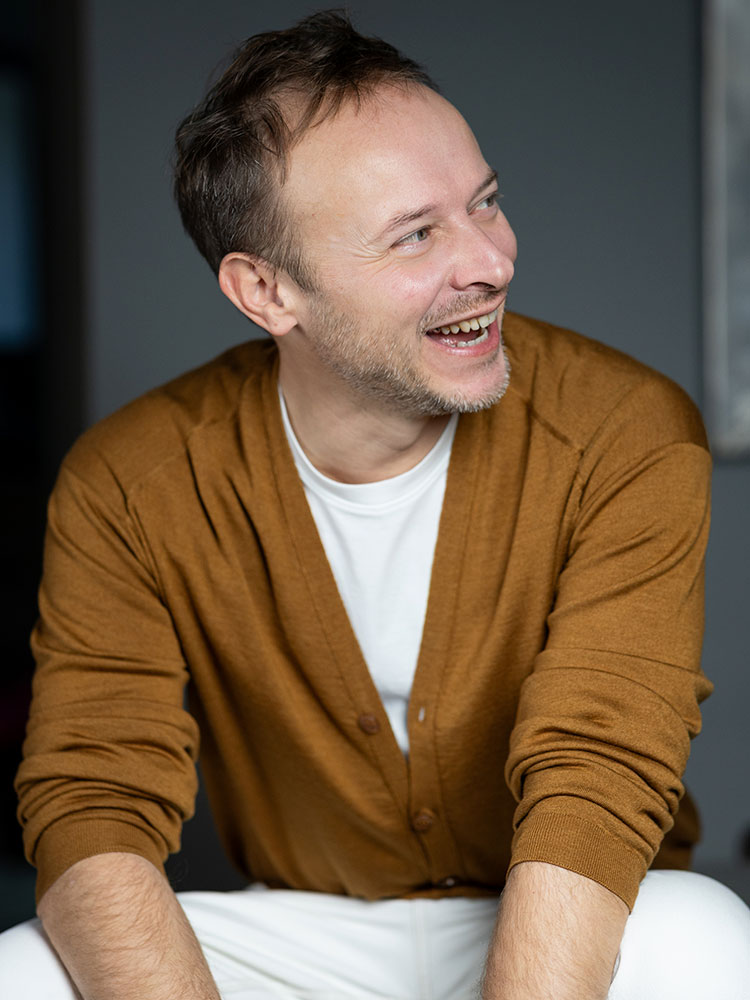
Portraits : Barbara Buchmann-Cotterot